


We act responsibly and transparently in the market, we conserve the environment, actively contribute to promoting important community values, care for the well-being of employees, ensure their equal rights and opportunities at work and adhere to the values of respect for people, society, and nature, which are enshrined in the company’s mission for nature, society, and employees.
In order to inform the public more effectively about the state and situation of forests, strengthening cooperation and contributing to the important goal of forest maintenance and nurturing, we organize various social campaigns for the public, expand forester initiatives by attracting more people to the forests and highlight the work of foresters.
The main areas of sustainability
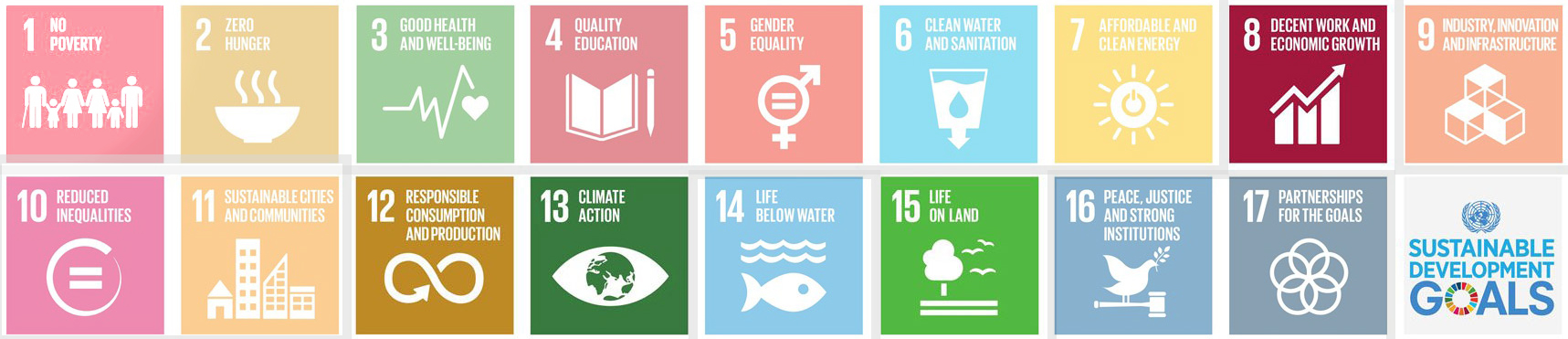
The Lithuanian State Forest Enterprise (SFE) responsibly contributes to the essential United Nations Sustainable Development Goals (SDGs). The company adheres to these goals in its activities, firmly committed to creating positive changes in the areas of environmental protection, social responsibility, and governance.
Decent work and economic growth
We actively care for the safety, health, and professional as well as personal development of our employees. We foster an organizational culture based on respect for human rights, tolerate no forms of discrimination or harassment and transparently implement clear principles of fair pay for work.
Responsible consumption and production
We efficiently utilize resources in producing products and services, apply qualitative and fair criteria to our partners, promote waste sorting, adhere to green criteria in public procurement. Competent forest management ensures effective CO2 sequestration and high-quality timber.
Climate action
The company’s operations are based on renewable raw materials and sustainable forest management, which contribute to mitigating climate change. The company’s prepared raw timber and forest residues help reduce GHG emissions, from which low-emission, renewable and recycled products are made, serving as an alternative to fossil fuels and other non-renewable materials. The company aims to reduce the energy consumption and GHG emissions associated with its activities and strives to become a climate-neutral company.
Forests, Land, Biodiversity
By sustainably managing forests, Lithuanian State Forest Enterprise contributes to increasing Lithuania’s forest cover, enhancing biodiversity and enriching forest ecosystems. The aim is to ensure the preservation of forest species and habitats.
The Lithuanian State Forest Enterprise operates according to a mission that defines the company’s long-term perspective: to actively contribute to increasing Lithuania’s forest cover, preserving biodiversity and forest ecosystems, and mitigating climate change. This mission is entrenched in the company’s strategy and reflected in its daily operations, aiming to reduce its negative impact on the environment. The company also implements specific nature management projects that contribute to reducing climate change, protecting ecosystems and maintaining biodiversity.
Our actions in the environmental field
Resilient forest formation
The consequences of global climate change include increasingly frequent strong winds and storms. In order to cultivate a strong and resilient forest, the Company performs timely thinning and selection cuttings – weak and damaged trees are cut down, leaving more space and light for healthy ones to grow. The forest grows stronger and withstands strong winds and storms. For this purpose, the Company conducts this type of forest cuttings annually in all forest groups and subgroups, except for reserve forests (group I forests). During these cuttings, the targeted species composition of forests is formed, their structure and density are regulated, and the resistance of forests to windbreaks, windthrows, snowbreaks, and other adverse environmental factors is increased. Additionally, these practices enhance the aesthetic and recreational functions of forests.
Forest fires prevention
As the climate heats up due to heatwaves and summer droughts, forest fires are becoming increasingly common. The Company pays special attention to fire prevention: it uses an underground automatic forest fire monitoring system, implements forest fire prevention measures, maintains vigilance for the onset of forest fires during favourable seasons, organizes rapid searches for forest fire sites and extinguishes forest fires that have erupted, preventing them from spreading into uncontrolled, natural disasters. These efforts undoubtedly contribute significantly to reducing global warming and reducing CO2 emissions.
Climate change mitigation
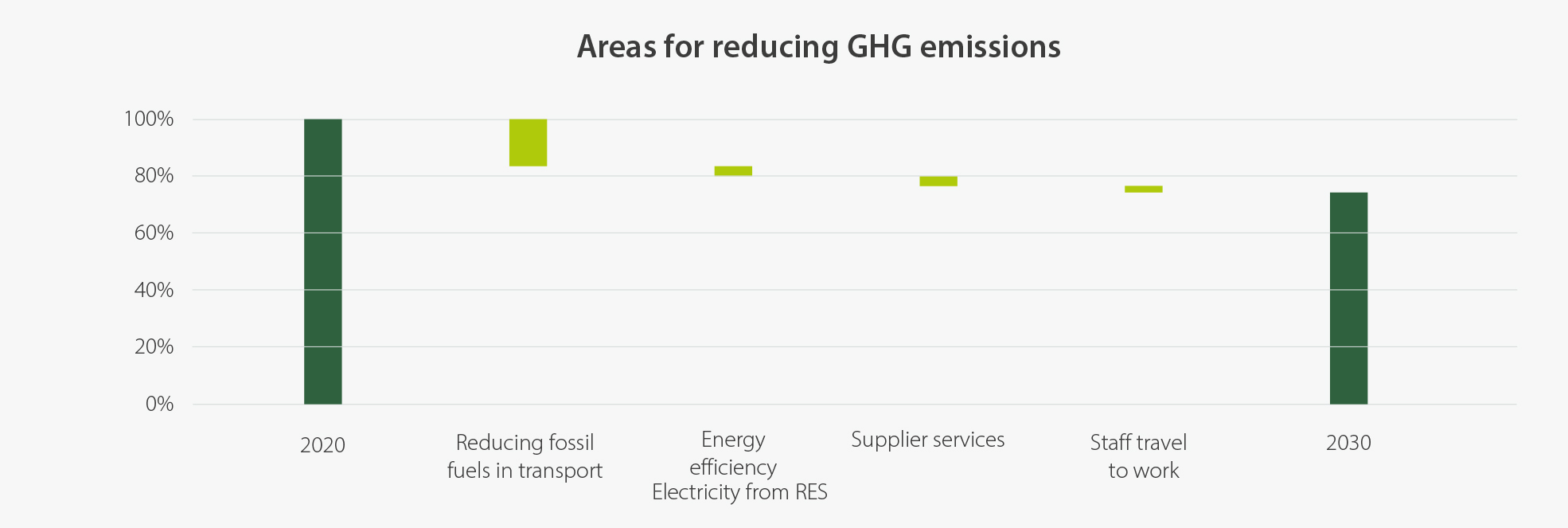
The Lithuanian State Forest Enterprise is committed to reducing greenhouse gas emissions and aims to become a climate-neutral company. The company continuously updates reduction measures, evaluates their effectiveness and monitors their implementation to achieve long-term goals. A significant portion of emissions is related to fuel use in heavy transportation. With the development of technology and the expansion of alternative fuels, significant emission reductions are possible in the future. It has been calculated that with existing measures, emissions could be reduced by up to 25% given the current activities and production volumes of SFE.
Forests play a crucial role in climate change mitigation because trees and vegetation absorb carbon dioxide, release oxygen and “lock in” carbon in wood mass. Therefore, it is essential to use timber grown in forests for various products, thus “preserving” CO2 for even longer periods and avoiding emissions from fossil fuel use. The annual absorption of CO2 is directly proportional to the volume of timber growth. Therefore, the maintenance of existing forests, reforestation efforts and the establishment of new forest areas are crucial for reducing greenhouse gas emissions and mitigating climate change.
Ecosystem protection and biodiversity conservation
SFE ensures the preservation of forest species and habitats and implements nature management measures for the protection of forests, wetlands and meadows. Nature management measures are active actions aimed at maintaining or restoring habitats of protected species or other protected natural habitats. Forest cuts for biodiversity maintenance are used to regulate the lighting conditions for undergrowth and medicinal plants in forests, improve the conditions for protected species and/or European Union priority animal and plant species and their habitats, restore or maintain the forest structure characteristic of EU priority habitats, improve feeding conditions for game animals, regulate the vegetation along water bodies, protect wetlands, sandy areas and other areas from overgrowth by woody vegetation and other nature management measures provided for in nature management, protected area management, protected species protection, invasive species abundance regulation action plans, projects or hunting management projects and integrated into internal forest management projects.
Care and protection of local ecosystems
SFE contributes to halting and restoring the decline of biodiversity. Therefore, it is particularly important to avoid and eliminate the causes of biodiversity loss and damage at an early stage, recognizing the invaluable value of biodiversity and the ecological, natural, social, economic, scientific, educational, cultural, recreational, and aesthetic importance of biodiversity and its components. Acknowledging the significant role of biodiversity in the evolution and preservation of life-supporting biosphere systems and recognizing that biodiversity conservation is a common human duty, is essential. The primary condition for preserving biodiversity is the conservation of ecosystems and natural habitats, maintaining and restoring viable populations of species in their natural conditions.
SFE, in implementing the country’s international and national commitments, ensures biodiversity by protecting natural habitats and wild fauna and flora within the territories of the European Union member states. The EU Council Directive 92/43/EEC on the conservation of natural habitats and of wild fauna and flora (the Habitats Directive) was adopted to preserve and improve the status of natural habitats and wild fauna and flora, as well as to protect wild bird species in the EU according to established conservation and use rules for these species.
Our environmental targets
Target | 2025 | 2026 | 2027 | 2028 | 2029 |
Annual greenhouse gas (GHG) absorption in green biomass, accumulated (uncut and undamaged) tree volume, million t CO₂ equivalent | 3.025 | 3.05 | 3.075 | 3.1 | 3.1 |
Share of renewable resources in the final energy consumption of buildings, % | 86 | 87 | 88 | 89 | 90 |
Average CO₂ emissions per vehicle per kilometer driven, compared to the amount determined in 2022, % | 83 | 74 | 63 | 54 | 38 |
CO₂ emissions from company operations per 1 m³ of produced wood, compared to the amount determined in 2022, % | 94 | 92 | 90 | 88 | 86 |
Annual energy savings of the company compared to the average annual energy consumption in 2019–2021 (88.9 GWh), GWh | 17 | 17 | 17 | 17 | 17 |
The main goal of the State Forest Enterprise is for employees to take pride in working for the company and being part of a harmonious team. Therefore, continuous development and initiative are encouraged, employee rights and freedoms are respected, efforts are made to attract and retain qualified employees and long-term partnerships are built with them based on the principle of mutual value creation, contributing to the successful future of SFE.
Our actions in the social topic
Diversity, equality and inclusion
The Lithuanian State Forest Enterprise fosters a values-based organizational culture and advocates for equal employee rights and opportunities at work, regardless of gender, race, nationality, language, social status, belief, convictions or views, age, sexual orientation, disability, ethnic affiliation or religion. The company has established an Equal Opportunities Policy.
Employee Safety and Health
The primary principle of SFE in terms of employee safety and health is to ensure the safety and well-being of every employee. This commitment includes adherence to occupational safety and health, fire safety requirements, and continuous improvement of safe and healthy working conditions. The company consistently prioritizes workplace safety and health protection by implementing preventive measures aimed at preserving employees’ work capacity, health, and life. These measures are utilized or planned at all stages of the company’s operations to protect employees from occupational risks or minimize them as much as possible. For newly hired employees, introductory safety and fire safety training is regularly conducted. Future employees are informed about identified potential occupational risk factors and their knowledge level is tested. The company organizes mandatory health checks, conducts occupational risk assessments in all workplaces, vaccinates all employees against tick-borne encephalitis and flu, maintains a registry of occupational diseases and their investigation and enforces safety through established procedures. Furthermore, knowledge is reinforced through training, participation in seminars and the continuous enhancement of responsible persons’ competencies.
Employee Well-being
The employer, concerned with the well-being and health of employees, has been providing voluntary health insurance to all employees after the trial period for the last three years. The company cares about employees’ psychological well-being by organizing various training sessions on how to manage stress, perform tasks more efficiently and avoid burnout. In complex situations, a team of psychotherapists provides psychological support not only to employees but also to their family members. Additionally, the company allows employees whose functions can be performed remotely to work from home.
Human Rights
SFE adheres to human rights protection principles in its operations, ensuring that it does not contribute to human rights violations and opposes any such breaches. The State Forest Enterprise has established an Employee Ethics Codex, committing to comply with legal and behavioural norms governing work activities, act socially responsibly, respect human rights and freedoms, and handle requests, complaints or reports fairly and objectively. The company avoids abusing its authority, performs duties diligently and responsibly within its competence and authority and acts in ways that increase trust in the company’s activities and its employees.
Employee training and education
Employees, by constantly learning and improving their knowledge and skills, help the company adapt to a changing environment. Therefore, SFE invests in continuous employee education. It fosters not only professional but also general competencies and invests in improving practical skills. To ensure that knowledge is absorbed and easily applied, internal training sessions are organized, where the highest qualified specialists in their field share their experience and knowledge with colleagues. The benefits of such training are immediately felt, so the company aims to grow its team of professional internal lecturers. SFE aims for improvement to be an ongoing process, and education to be conducted through various methods. Therefore, employees, especially those planning internal career advancement, are encouraged not only to learn but also to pursue further education. The target set for 2022 was to improve the quality of training, which was successfully achieved by 2023. In 2024, the initiative was implemented with results surpassing the initial targets. During feedback surveys, employees rated the quality of organized training at 8.8 out of 10. The main focus was on deepening the professional knowledge of forestry specialists.
Community engagement
Working with “Jaunieji miško bičiuliai” has always been an integral part of foresters’ work. Foresters have been nurturing students who share a love for nature and are interested in the forestry profession for many years, fostering a conscientious and curious generation of forest enthusiasts. Since the revival of the Young Friends of the Forest group’s activities in 2021, VMU has taken on the coordination role, conducting educational activities about forests and inviting all nature lovers interested in learning more about forestry, expanding their knowledge of nature, forests, and their preservation to join group activities.
We began implementing the pilot project “Pamokos miške”. The pilot project “Pamokos miške” was initiated for the academic years 2023-2024, aiming to contribute to the education process of students and deepen their knowledge of natural sciences through practical lessons and more activities in forestry. It is planned to invite over 1,000 Lithuanian students from eight Lithuanian municipalities to the “Pamokos miške” project. Fifteen general education institutions have joined the pilot project. For the academic year 2024-2025, the project’s activities are planned to be expanded to four more Lithuanian municipalities, providing the opportunity for students from eight more general education institutions to participate in the project.
Nesting-box raising feast. Every March, foresters across Lithuania invite people to welcome back returning birds and put up new homes for them during the traditional Nesting-box raising feast “Paukščiai grįžta namo”. The festival attracts forest lovers and Young Friends of the Forest from all over Lithuania. Every year, SFE foresters raise more than 8,000 nesting-boxes, which become homes for returning birds.
The national forest planting event. The National Forest Planting event, which has become a tradition over several decades, brings together adults and children, representatives of various professions, companies, and organizations for tree planting. During the event, saplings of spruce, pine, birch, lime, and oak are usually planted in various areas across all 25 regional units. This is one of the most beautiful and meaningful activities that exemplifies human love for nature. In 2024, the National Forest Planting event saw a record number of participants, with about 15,000 people taking part.
The “Parsinešk Kalėdas į savo namus” tree branch distribution campaign. Before the major holiday season, SFE foresters traditionally give away spruce branches to residents in city squares and town centers through the “Parsinešk Kalėdas į savo namus” campaign, which has been running for over a decade. Through this initiative, forest maintenance specialists encourage people not to cut down young fir trees, not to break their branches and promote sustainable and eco-friendly consumption. During the campaign, over 100,000 spruce branches are distributed throughout Lithuania, bringing Christmas joy to people’s homes. In 2023, foresters, in collaboration with Red Cross volunteers, decorated the homes of 3,000 lonely seniors with spruce branches. The free spruce branch distribution campaign, first organized by the foresters of the Šiauliai region 17 years ago, is one of the most anticipated and attention-grabbing events organised by SFE.
Forest clean-up “Miško kuopa”. To clean up forests from litter, which becomes pollution and fire hazards in Lithuanian forests, and to educate the public about sustainable and responsible behavior in nature, the traditional foresters’ events were supplemented with the forest clean-up day held in September. Citizens who care about forest cleanliness across Lithuania participate in this initiative. In 2023, for the third time, the nationwide forest clean-up took place on September 9th, becoming a traditional and continuous initiative aimed at bringing together nature-loving communities to clean up forests from litter, which becomes pollution and fire hazards in Lithuania, and to educate the public about sustainable and responsible behavior in nature. “Miško kuopa” took place in all SFE regional units. This year’s event brought together over 1,000 volunteers, who collected a record amount of various waste – about 115 tons throughout the forests of Lithuania. “Miško kuopa” has become a tradition, combining elements of nature conservation, management, and community involvement. In 2021, about 50 tons of waste were collected and in 2022 – 90 tons. These numbers indicate that people see more and more value in contributing to events organized by foresters.
Forester’s Day Events. Every September, the State Forest Enterprise invites everyone to celebrate Forester’s Day together. Throughout September, foresters from various regions of Lithuania organize hikes, excursions, deer rutting listenings and hold interesting and useful educational events. All events are free.
The “Medžiotojas ir medelis” campaign. For the first time in October 2023, a meaningful campaign uniting hunters and foresters took place, during which more than 200 hectares of forest plantations supervised by SFE were treated with repellents to protect young seedlings from damage by wild animals. Over 500,000 seedlings were protected. The first “Medžiotojas ir medelis” campaing received significant involvement from hunters – more than 1,500 members of the Lithuanian Hunters and Fishermen Association joined foresters in joint efforts.
Our social targets
Target | 2025 | 2026 | 2027 | 2028 | 2029 |
Increase in the number of “Jaunieji miško bičiuliai” groups, units | 88 | 93 | 98 | 100 | 100 |
Number of people who participated in forestry events organized by SFE | 18 500 | 19 000 | 19 500 | 20 000 | 20 500 |
LTIIR rate of lost time due to accidents (number of injuries per 1 million working hours) | <2,8 | <2,7 | <2,6 | <2,5 | <2,4 |
Confirmed human rights violations, units | 0 | 0 | 0 | 0 | 0 |
Voluntary employee turnover rate, % | <12 | <12 | <12 | <12 | <12 |
Employee engagement index | 70,6 | 71,6 | 72,6 | 73,6 | 74,6 |
The company’s environmental, social, and economic impact management is overseen by the board and its members aswell as management (C-level directors). The board reviews the results of impact management once a year, evaluates the company’s strategy and the Ministry of Environment approves the strategy. Responsibility for sustainability in daily operations is delegated by the board to responsible managers and company employees according to significant sustainability issues. Designated individuals regularly report to the board on the results of environmental, social, and economic impact management, providing reports during weekly, monthly and annual meetings as needed.
Anti-corruption environment
The SFE management is subject to transparency requirements and promotes responsible, open, and ethical conduct. SFE adheres to a zero-tolerance policy towards corruption, zero-gift policies, and the principles of unavoidable responsibility in its activities. Commitments related to anti-corruption activities are outlined in the Anti-Corruption Policy, the Employees’ Codex of Ethics, and the Gift Policy, which are publicly available on the company’s website.
In 2023, the company implemented an Anti-Corruption Management System that was certified. The ISO 37001:2017 (ISO 37001:2016) standard compliance certificate awarded to the company covers the following areas: comprehensive forestry activities, management, use, and disposal of state forests, forestry management, nursery activities, forest infrastructure maintenance, implementation of social functions in state forests, organization of professional hunting, protection of state forests, and other commercial activities.
ISO 37001:2016 Management System Certificate
Ensuring personnel reliability
The company aims to ensure that individuals recruited and employed by SFE meet specified requirements and do not pose risks of corruption or conflicts of interest, as reliable personnel are an integral condition for creating a secure and corruption-resistant environment at SFE. In 2023, the list of positions for which a request for information is submitted to the Special Investigation Service was updated and made publicly available on the SFE website.
Transparent public procurements
The successful operation of the company requires a wide variety of services, goods and works. To ensure transparency in public procurement processes, employees participating in these procedures have submitted declarations of private interests to the Chief Ethics Commission, signed declarations of impartiality, and pledged confidentiality. Standardized documents have also been prepared to ensure the application of uniform requirements and conditions, thereby promoting equal competition. The majority of the company’s public procurements are centralized, enabling a unified public procurement process and ensuring the proper implementation of legal requirements. It is noteworthy that when conducting advertised procurement procedures, the company provides equal opportunities for market participants to submit bids and compete fairly, thus gaining public trust and properly implementing principles of transparency, supplier equality and others. The company fosters an environment intolerant of corruption. Depending on the procurement object, the suitability of suppliers is evaluated during public procurement procedures, considering their economic, financial, technical and professional capacities. Measures are taken and requirements are set during public procurement procedures to ensure compliance with environmental, social, and occupational safety standards by suppliers.
Sustainable forestry management
One of the tasks is to comply with the requirements of the Forest Stewardship Council® (FSC®) national standard for forest management in Lithuania. FSC® is an independent international forest management evaluation and timber origin labeling system. It provides consumers with assurances that the products offered are made strictly adhering to sustainable and balanced forestry principles. Sustainable and balanced forest management principles are followed in the state forests of Lithuania, which are managed by the Lithuanian State Forest Enterprise under delegation. State forests began to be certified under the FSC® system in 2001. Certificates are issued for 5 years, and an annual audit of compliance with the standards is conducted. Currently, all state forests in Lithuania have FSC® forest management certificates. In 2024, FSC® Forest Management and Chain of Custody audits were conducted in all forests managed by SFMC. Summaries of the audit reports are publicly available on the FSC International® website (in Lithuanian).
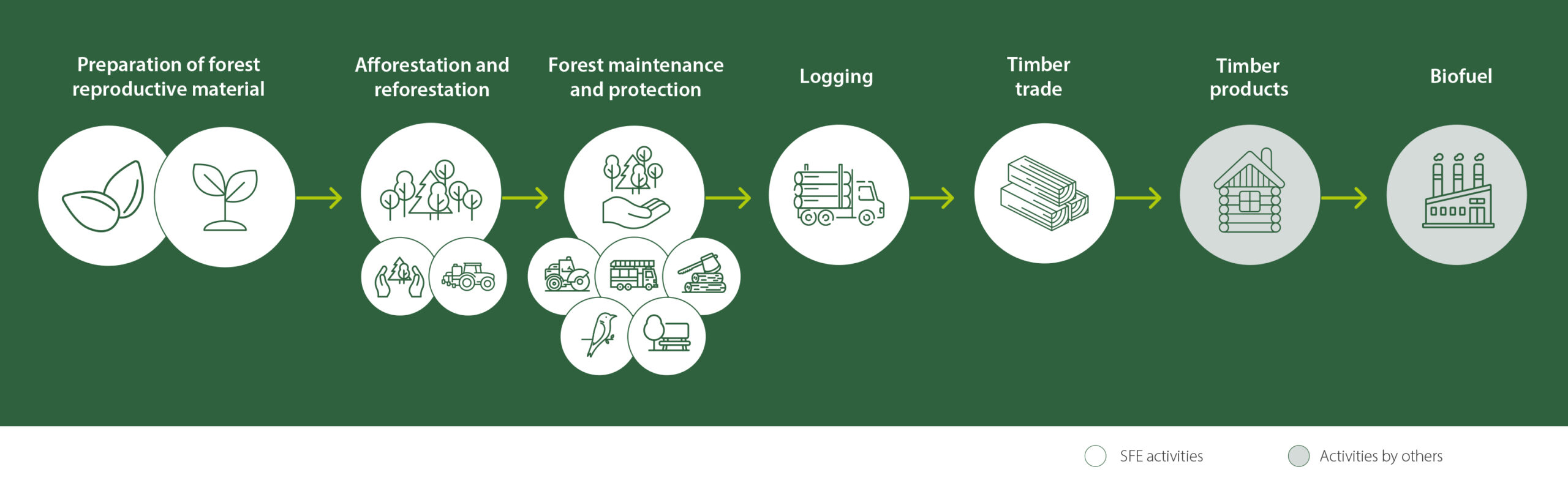
The preparation of timber and the trade of manufactured products by the State Forestry Enterprise are organized in accordance with the requirements of Regulation (EU) No 995/2010 of the European Parliament and of the Council (hereinafter referred to as the EU Timber Regulation). The regional units of the State Forestry Enterprise are certified according to the LegalSource standard, which is harmonized with the EU Timber Regulation. The LegalSource certificate demonstrates that the regional units of the State Forest Enterprise cut trees, transport and trade in the produced products in compliance with the requirements of EU and national legislation, thereby reducing the risks of illegal timber products entering the regulated market.
ESG risk management
Environmental, social, and governance (ESG) risk management, hereafter referred to as ESG, is integrated into the management of business processes and is an inseparable part of operations. In accordance with the Risk Management Policy (in Lithuanian), continuous assessment of potential threats and risks is conducted, key risk indicators are monitored, monitoring of indicators and risk management measures is carried out and reports are provided to the Audit Committee and the Board. Risk and incident management, internal control, are conducted within the Risk Management Information System, where information on changes in company risks, the results of risk management measures, the implementation of internal control measures, and events affecting risks are provided and managed in one place.
Our governance targets
Target | 2026 | 2027 | 2028 | 2029 | 2030 |
Share of state forests managed by SFE with FSC certification, % | 100 | 100 | 100 | 100 | 100 |
Maintained State-Owned Enterprise (SOE) good governance index, level | A+ | A+ | A+ | A+ | A+ |
Number of confirmed legal violations, units | 0 | 0 | 0 | 0 | 0 |
The Sustainability policy (in Lithuanian) of SFE establishes the company’s sustainability directions and principles, which guide the creation and development of a responsible business culture and practices. The company annually prepares Sustainability Reports in accordance with the United Nations Global Compact principles and the Global Reporting Initiative (GRI) standards. The Sustainability Report provides information reflecting the company’s activities and progress in the areas of environmental protection, social responsibility and good governance, and highlights the company’s operations in the context of social responsibility.
2024 management (including sustainability) report (in Lithuanian)
2024 GHG emissions management plan (in Lithuanian)
2024 I half-yearly activity report and sustainability (social responsibility) review (in Lithuanian)
2023 annual and sustainability report (in Lithuanian)
2023 GHG emissions management plan (in Lithuanian)
2022 annual and sustainability report (in Lithuanian)
2022 GHG emissions management plan (in Lithuanian)
2021 annual and sustainability report (in Lithuanian)
2020/2021 GHG emissions management plan (in Lithuanian)
2020 annual and sustainability report (in Lithuanian)
